Reducing academic pressure and college anxiety in high school students
Program fact sheet, 2025–2026
A student-led mental wellness program for schools and communities
Tri-Valley, California
Dear Future Me is a peer-led mental wellness program built by three students in California’s Tri-Valley. Over the 2025–2026 program year we surveyed 1,109 students before and after taking part, and the primary measure of academic anxiety fell 15.9% (p < 0.00001). The program placed second in California at the HOSA State Leadership Conference in 2026 and earned chapter recognition at the international conference the year before.
Recognition
- Second place in California. Emotional Well-Being Challenge, HOSA State Leadership Conference, 2026.
- Recognized at the international conference. Scored above the 70% threshold at the HOSA International Leadership Conference in 2025, earning a certificate and a stage recognition pin.
The “why” behind Dear Future Me
Dear Future Me was created out of deep personal tragedy and an urgent need for change. In our competitive Bay Area high school, we have seen our close friends struggle with severe mental health crises and have lost 5 of our classmates to suicide during our time in high school. We are dedicated to breaking the culture of silent suffering, changing the belief that academic achievement defines personal worth, and ensuring no student feels completely alone in the pressure they carry.
If you are struggling, you are not alone. In the US you can call or text 988 at any hour to reach the Suicide & Crisis Lifeline.
The problem
Students in California’s Tri-Valley attend some of the most academically competitive high schools in the state. The Hechinger Report found in 2024 that 48% of students let stress and anxiety overshadow their college search, and wellness centers in our own district report the same pattern: more visits for burnout and stress headaches; more days missed. No initiatives focus on addressing the root cause: students tying their entire sense of self worth to academic achievement.
How the program works
A free, anonymous web platform pairs with in-person workshops. Nothing is graded, and no response is tied to a student’s name. The platform itself has three parts.
- Non-resume accomplishments. An anonymous feed for the things students are proud of that no college application would ever ask about. Real entries: fixed my own bike chain, taught my little brother to tie his shoes.
- A letter to my future self. Written now, kept, and reread when they need it.
- Vision boards. Built in Google Slides or Canva, then posted anonymously to a moderated wall that every participant can browse.
Alongside the platform we run peer-led class presentations, craft and reflection workshops, and community speaker events. In 2025–2026 these reached roughly 720 students in person at 8 schools, part of outreach to 26 schools across Dublin, Pleasanton, and San Ramon Valley. Because the platform is open to any student, survey participation ran ahead of in-person attendance.
Before and after
Students answered the same questions before and after the program on a five-point scale. Every measure of stress fell, and the measure of help-seeking rose.
| Question | Before | After | Change |
|---|---|---|---|
| Overwhelmed by school and college | 3.95 | 3.32 | −15.9% |
| Academic pressure | 3.90 | 3.47 | −11.0% |
| GPA defines personal worth | 3.60 | 3.19 | −11.4% |
| Physical stress symptoms | 3.42 | 2.92 | −14.6% |
| Isolation from competition | 3.19 | 2.77 | −13.2% |
| No time for hobbies | 3.18 | 2.89 | −9.1% |
| Comfortable asking for help | 2.11 | 2.80 | +32.7% |
Questions were written against DSM-5 criteria for academic anxiety and administered under HIPAA guidelines. Completion was 79.0% before the program and 98.7% afterward.
Statistical significance
On the primary question, whether a student feels overwhelmed by school and college, a matched-pairs t-test across the 703 students who completed both surveys put the mean at 3.95 before and 3.32 after. At 702 degrees of freedom that gives t = −14.22 and a p-value below 0.00001 (well under the 0.01 threshold), so we reject the null hypothesis of no change. Cohen’s d is 0.76, a medium-to-large effect. One caveat belongs with that number: only 703 of the 1,109 participants completed both surveys, so the test describes that subset only.
Goals and results
Goal Attainment Scaling: 0 is the outcome we expected, +2 is well above it. Two of three were exceeded, none missed.
| Goal | Result | Score |
|---|---|---|
| At least 85% of students can name three or more coping strategies | 89% could, above target | +2 |
| Raise help-seeking confidence by at least half a point, with at least 75% willing to seek help | Confidence rose about 0.7 points; 81% said they would seek help | +1 |
| Cut academic anxiety on the primary question by at least 10% | It fell 15.9%, well past the target | +2 |
In the community
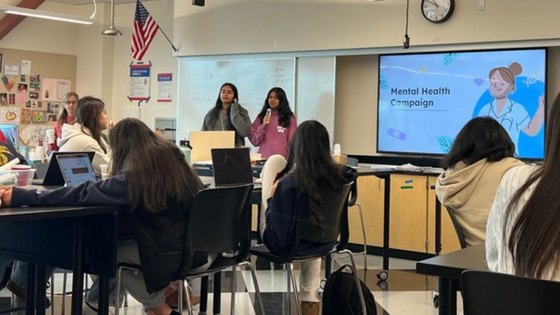
School presentations
Peer-led sessions in three districts.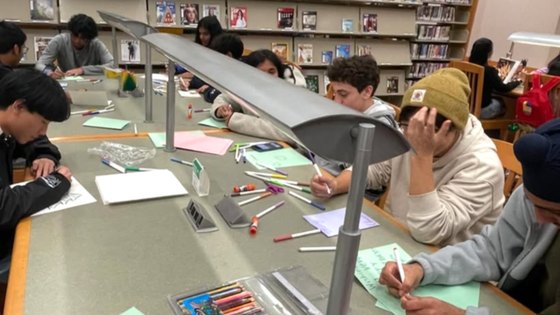
Livermore public library
50+ attendees wrote 200 cards.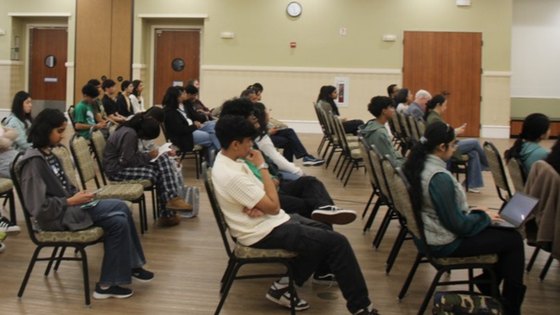
Dublin Senior Center
Speakers and partner booths.What students said
“Writing to my future self made me step back and realize it’s okay to not have everything figured out yet.”
Anonymous post-program response, grade 10
“The accomplishment board made me realize I compare myself to others too much. Now I’m focusing on my own progress.”
Anonymous post-program response, grade 11
The team
Dear Future Me was founded by Suhani Gupta, Tanvi Bharadwaj, and Nikhilesh Suravarjjala. All three are certified in Be There, the peer mental health support training developed by jack.org with the Born This Way Foundation.
Partners
Partners include the Neuro Health Alliance, the Dublin Mayor’s Council, NAMI Tri-Valley, the Dublin High Wellness Center, and the Livermore public library.
What we are looking for
- Schools and districts willing to run it. Nothing to license, nothing to buy. We hand over the surveys, slides, and facilitation guide, and will run the first session with you.
- Distribution partners for Dear Future Me India. A version built for students under NEET and JEE pressure, where they can write anonymously to society about the pressure they carry. The site is still in development.
- Funding. For the India build and for workshop supplies.